Generic selectors
Exact matches only
Search in title
Search in content
Post Type Selectors
Generic selectors
Exact matches only
Search in title
Search in content
Post Type Selectors

Crystalline Waterproofing for Concrete Structures: A Practical Guide

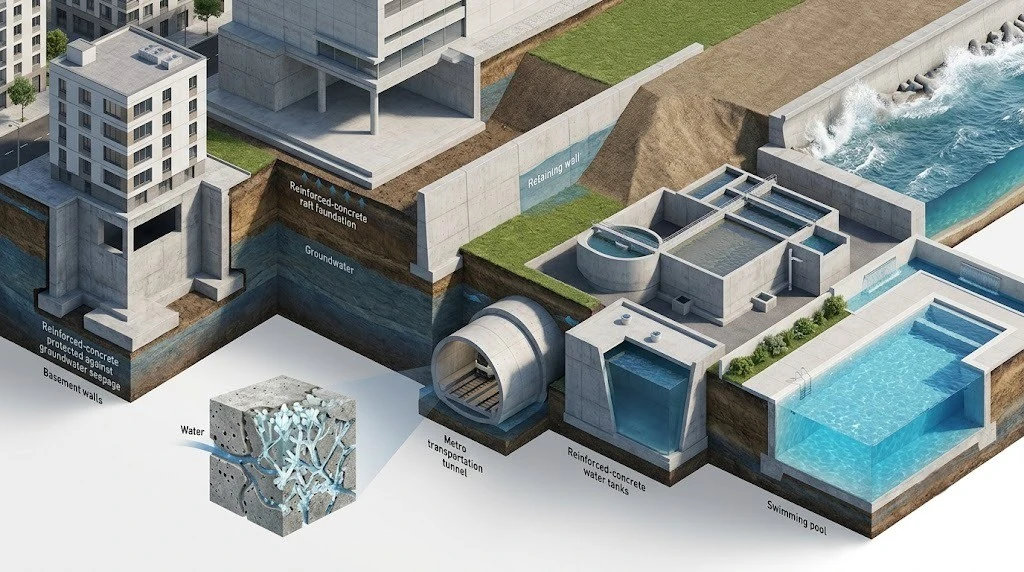
Although concrete is strong and durable, it can allow water infiltration through pores, capillaries, joints, fine cracks, etc., which can cause issues in moisture exposed concrete structures such as basements, foundations, tanks, pools, tunnels, etc. Crystalline waterproofing is effective at reducing water penetration because it reacts with the moisture and cementitious materials to form insoluble crystals in the appropriate pores and capillary ways. 

Its effectiveness relies on the quality of the concrete, surface preparation, surface cracks, application, curing, and the appropriate system selection, so it is important to know its capabilities and limitations prior to specifying it.

Understanding Water Movement Through Concrete

Although dense and impermeable, hardened cement paste is composed of interconnected pores and capillaries whose size and connectivity are affected by the water cement ratio, hydration, compaction and curing. If these pathways are not severed, the moisture will flow through the concrete and water penetration will be more likely in a below grade structure if hydrostatic pressures are high. 

Therefore, in order to be effective, waterproofing must start by locating and determining the route of the water infiltration, otherwise the entire system may be compromised by applying a waterproofing material, in the absence of solving the underlying defects.

How Crystalline Waterproofing Works

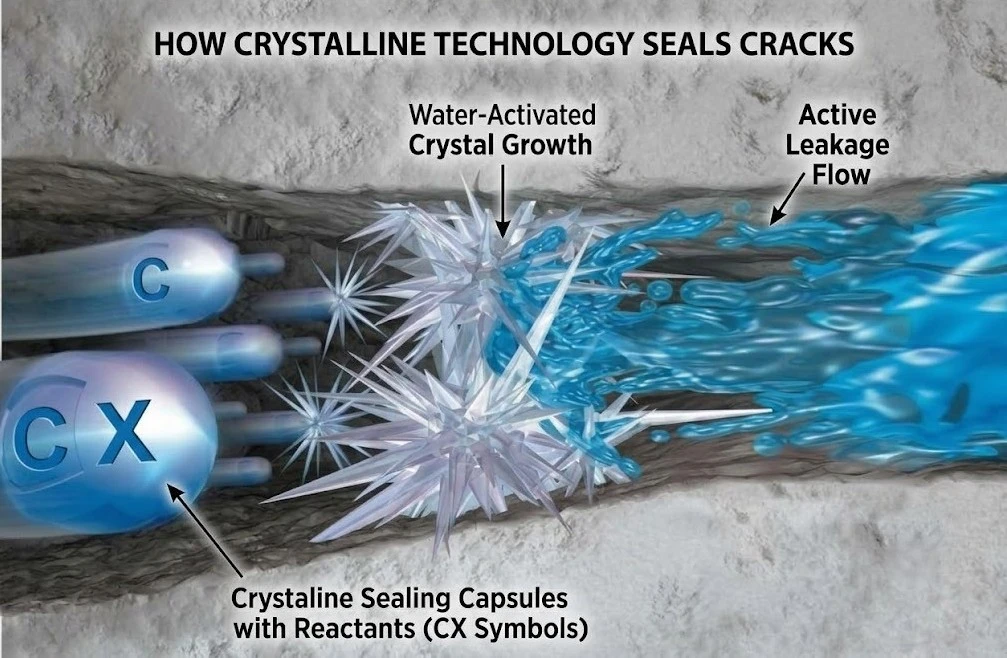
The mechanism of crystalline waterproofing is different from the conventional surface membranes. Generally, these waterproofing formulations consist of a cementitious system that provides reactive components, which on contact with moisture and compatible components in the concrete, react and form insoluble crystalline structures in suitable pores and capillary paths that help to reduce the paths available for water flow. 

In simple terms, moisture + reactive chemicals + cementitious environment → crystalline formation → reduced water pathways.

It can be used as a surface application or as an integral admixture or as a specially formulated material for joints and concrete repair and is not a single standardized material, but rather a technology category.

Crystalline Waterproofing

Is Crystalline Waterproofing good for sealing cracks in concrete?

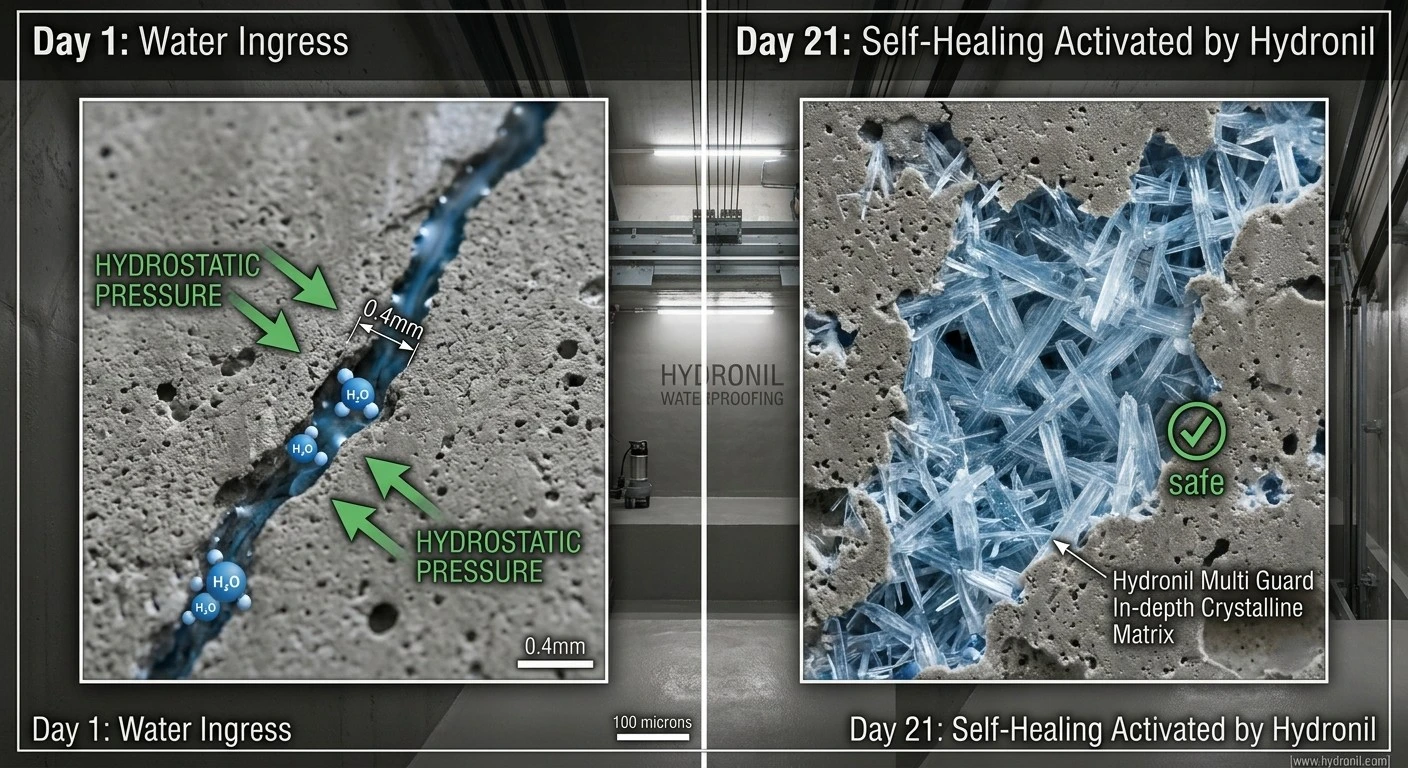
One of the best features is the fact that it “selfheals” minuscule cracks. It is not “magic”, though. It will not repair all cracks, and it is not a replacement for structural repairs. The effectiveness is dependent on the size of the fissure, whether the fissure is moving, and the wetness of the fissure for a period of time.

  • The Size Limit: of the high quality crystalline products are tested to seal tiny non-moving cracks of width up to 0.4 mm (which is around the thickness of a thick fingernail or a credit card).

Static Cracks vs. Dynamic Cracks

  • Static Cracks (Movement ≤0.05 mm): These cracks are subjected to very small cyclic thermal or mechanical movements. If cracks are not to wide (0.3 mm to 0.4 mm), moisture continually or intermittently triggers the dormant chemicals, thus forming dense crystallized matrices that will completely inhibit fluid passage.
  • Dynamic Cracks (Cyclic Movement >0.1 mm): are caused by live-load structural deflection, wind-load drift, thermal expansion and undergo continuous dimensional changes. Crystalline deposits are hard and brittle mineral deposits that have a tensile elongation of zero. The repeated opening and closing process will cause the crystal matrix to break and lead to the phenomenon of leakage of water repeatedly.
  • Engineering Remedy: In such cases as active dynamic cracks, structural expansion joints or tie-rod holes, high-performance polyurethane/epoxy injection resins, hydrophilic waterstops or flexible elastomeric joint sealants that can accommodate 25% to 50% movement joints must always be used in conjunction with crystalline coatings.

The influencing factors of performance of the crystalline waterproofing.

Crystalline waterproofing is more than a magic potion paint as its success depends on physics, chemistry and correct job site implementation. The best crystalline product is no good if the adjacent concrete or conditions of application are not good. Water-to-cement ratio and concrete porosity.Water-to-cement ratio and the porosity of concrete.

1. Concrete Porosity and Water-to-Cement Ratio

Effectiveness of the crystalline chemicals in your concrete depends on the density of your concrete.

  • The Problem: Excess water during the batching process (High Water to Cement ratio) will form a network of dense large interconnected capillary pores.
  • The water-cement ratio should be kept between 0.42 and 0.45 for long-lasting and low permeable concrete. In addition, crystalline chemistry needs dry particles of cement to react with. If the concrete mixture is poorly designed, or lacks sufficient cement content, the crystalline treatment won’t have a sufficient amount of material to anchor and grow.

2. Moisture availability – The Crucial Catalyst

Crystalline waterproofing requires moisture in order to cure and dry, whereas a standard membrane does not require moisture.

  • The Rule: Crystals will not grow in a dry environment. Surface applied coatings need to be applied over dried concrete (Damp Saturated Surface) before the coating.
  • The Timeline: The product has to be mist sprayed or fog cured several times daily (usually 3 to 4 times) for 48 to 72 hours after application. The chemical reaction ceases if the coating dries rapidly in the sun or wind.

3. Surface preparation and cleanliness of the concrete.

Surface-applied crystalline products must be able to penetrate into the actual concrete pores; they will not adhere to dirt, grease or poor quality top layers.

  • Aim for an ICRI (International Concrete Repair Institute) Concrete Surface Profile of CSP 3 to CSP 5, with the Prep Standard: Contractors should aim for an ICRI (International Concrete Repair Institute) Concrete Surface Profile of CSP 3 to CSP 5.
  • This is done by abrasive blasting, scarification or high pressure water blasting (usually at a pressure between 3,000 and 5,000 psi). This removes weak surface cement paste (laitance), oil and curing compounds, leaving the raw concrete pores free to allow the crystalline chemicals to penetrate.

4. Construction Joints and Penetrations

Water will flow through the easiest path. If you have treated your concrete walls completely, there are still weak links in the system that will allow water to seep through. In fact, industry statistics indicate that as many as 70% of basement and foundation leaks occur at construction joints, pipe penetrations, tie rod holes and honeycombed patches. These cannot be filled by a crystalline coating. High-risk areas need special attention, including swellable hydrophilic waterstops, cast in joints or special repair mortars.

5. Hydrostatic Pressure and Groundwater Chemistry.

Not all water is equal, and the pressure it exerts varies drastically depending on the depth of the structure and local soil conditions.

  • Pressure Limits: High-grade crystalline systems are generally lab-tested to withstand a hydrostatic pressure head of up to 7 bar (approx. 100 psi, or 70 meters of water head) from either positive or negative sides.
  • Chemical Resistance: Good crystalline treatments also help protect concrete against aggressive groundwater chemistry, enduring environments with a broad pH range (typically pH 3 to 11) and resisting sulfate attacks. Always check manufacturer test data for your specific site conditions rather than relying on generic “waterproof” claims.

Crystalline Waterproofing vs Conventional Waterproofing

Feature Crystallization Waterproofing Conventional Surface Waterproofing
Core Mechanism Active chemicals react with moisture and unhydrated cement to grow needle-like crystals deep inside concrete pores. Forms a physical barrier, film, or sheet membrane directly on top of the concrete substrate.
Active Self-Healing Yes. Can autonomously seal static micro-cracks up to 0.4 mm when exposed to future moisture. No. If the membrane tears, cracks, or punctures, water bypasses the barrier completely.
Application Side Works on both positive (water-facing) and negative (back-pressure) sides of concrete. Mostly restricted to the positive side; prone to peeling or blistering under negative water pressure.
Substrate Bond Integrates into the concrete matrix; it cannot peel or delaminate from the surface. Adheres to the surface; vulnerable to bond failure if moisture vapor escapes from below.
Lifespan Lasts as long as the concrete structure itself because it becomes part of the concrete. Typically lasts 10 to 20 years; eventually requires maintenance, patching, or complete re-application.
Surface Prep Sensitivity Requires open, porous concrete (often acid-etched or power-washed) for chemicals to penetrate. Requires a clean, sound surface, but relies heavily on primer and surface adhesion rather than absorption.
Crystalline Waterproofing

Types of Crystalline Technology Explained

Not all crystalline technology is applied the same way. Depending on whether you are pouring a brand-new foundation or repairing a leaking basement wall, the technology is deployed in one of three forms:

Crystalline Admixtures (In Wet Concrete)

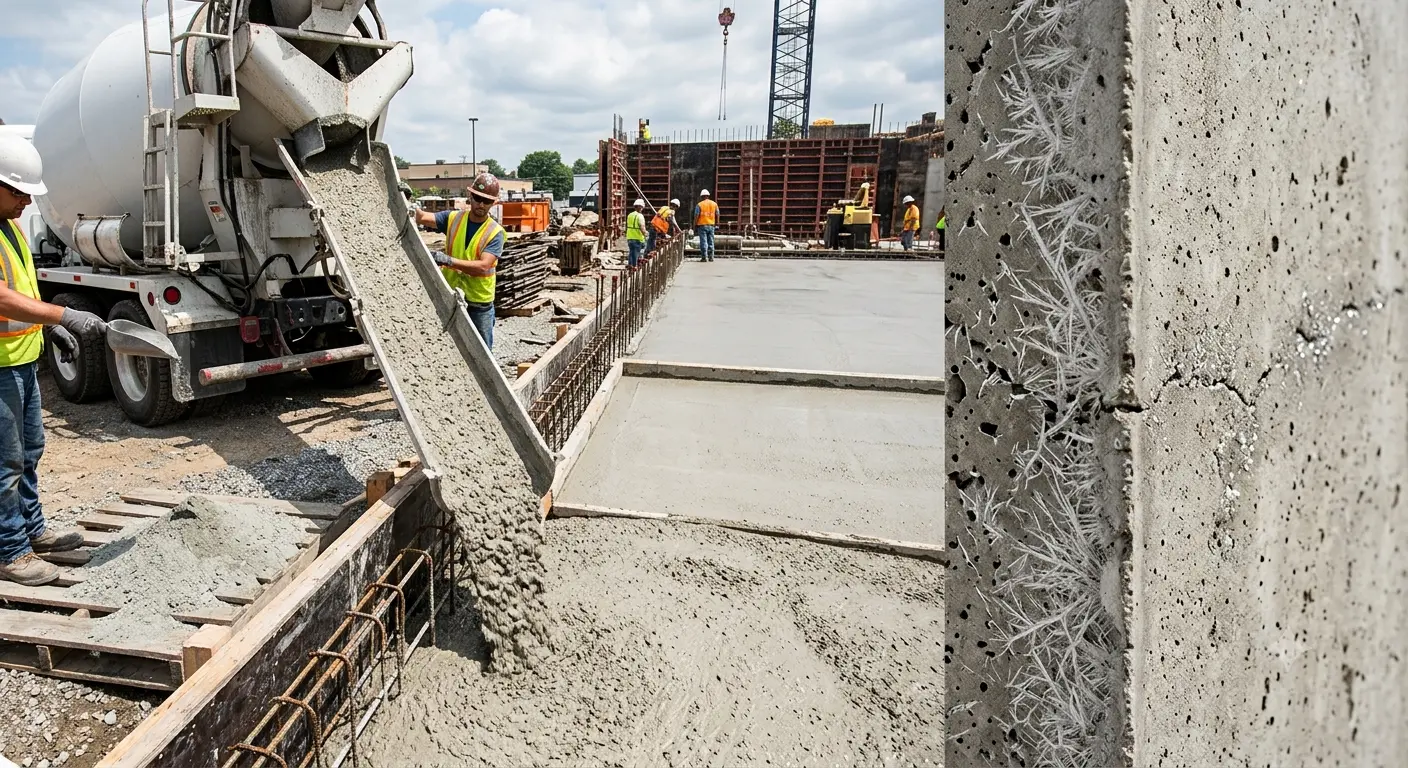
  • What it is a dry powder that is added directly into the concrete mixer truck “on site” prior to the pouring of the concrete.
  • Why it adds value it creates a waterproof barrier from the inside out of the entire mass of the concrete structure. No membrane to perforate during construction or backfilling, and it is the gold standard for massive swimming pools, massive retaining walls and massive subterranean structures.

Brush/Spray Applied Crystalline Coatings

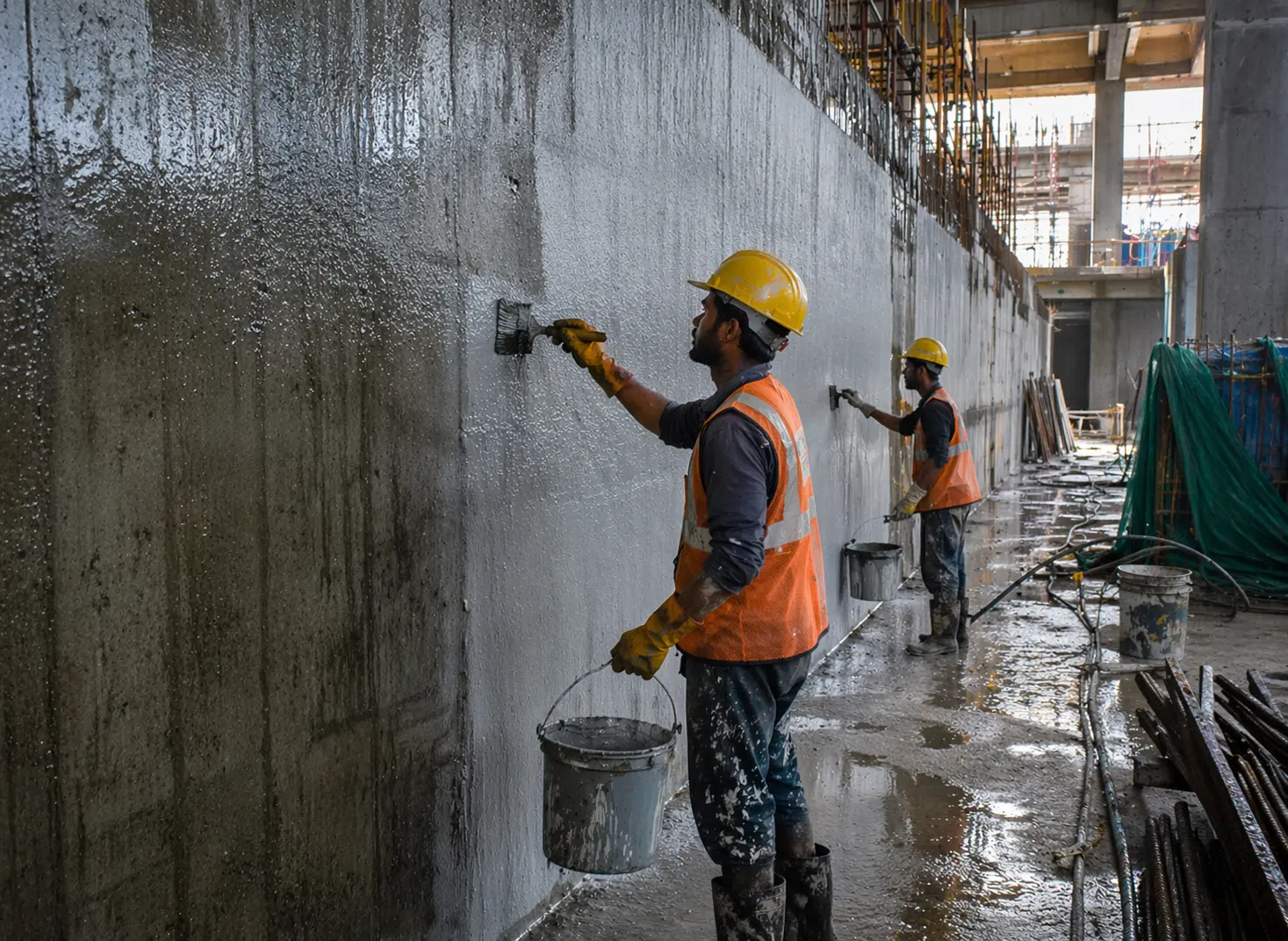
  • What it is: A powder that is mixed with water, and then painted or sprayed onto existing, cured concrete (such as painting a wall).
  • Why it adds value: This is the most comprehensive retrofit tool available. If a basement already exists and is leaking from the inside (Negative side water pressure) then prep the wall, wet the wall and brush this coating onto the wall. The active chemicals draw moisture into the concrete and create crystals in the old concrete pores.

Dry-Shake / Surface Hardeners (During Floor Paving)

  • How it’s used: It is broadcasted directly onto freshly poured horizontal concrete slabs, such as floor slabs or parking decks, just before finishing and troweling the slabs.
  • How it adds value: Provides a seamless, thick, waterproof, durable coating on top of slabs-on-grade and garage floors, or industrial warehouse foundations, which prevents rising dampness into the building.

How to Select the Right Crystallization Waterproofing System

An integral admixture could be useful for a new reinforced concrete raft foundation, and a surface applied treatment could be necessary for an existing basement wall in addition to some localized crack repair.

The following technical checklist is provided for consultants, contractors and project engineers to review and determine if the system is suitable.

Special consideration must be paid to the suitability of the product for potable water contact and necessary approvals when using these tanks for potable water. The resistance to hydrostatic pressure and the integration of joint waterproofing are especially important in underground structures.

Selection Parameter Information to Verify
Structure type Basement, raft, retaining wall, tank, tunnel or reservoir
Construction stage New concrete or existing structure
Water exposure Intermittent moisture, standing water or continuous groundwater
Hydrostatic pressure Expected water head and pressure direction
Concrete condition Strength, porosity, curing, defects and existing coatings
Crack characteristics Width, depth, activity and likelihood of future movement
Application method Surface treatment, integral admixture or repair material
Joint detailing Construction joints, expansion joints and pipe penetrations

Conclusion

For top performance in this category, systems such as those from Hydronil with their innovative Multiguard In-depth crystalline technology are outstanding options for new construction and retrofitting solutions. A special formulation has been developed which will resist very high hydrostatic pressure heads (up to 17 bar) and makes porous concrete an active self-sealing barrier to water intrusion, chemical attacks and chloride corrosion. High-performance crystalline solutions, such as Hydronil, offer engineers and builders an unmatched structural integrity solution for a basement, water tank, or structure below grade where waterproofing is a must for a lifetime.

Hydronil's Product Lineup

  1. Multiguard In-Depth Type A (MITA): A high-performance crystallization treatment that penetrates concrete to provide permanent protection against water ingress, even under high hydrostatic pressure.
  2. Multiguard In-Depth Type B (MITB): A cost-effective waterproofing system treatment for concrete exposed to low or negligible hydrostatic pressure.
  3. Multiguard In-Depth Type D (MITD): A single-component cementitious waterproofing treatment that penetrates concrete and masonry to provide long-lasting protection against water and waterborne chemicals.
  4. Multiguard In-Depth Primemix (MIP): A crystalline admixture added to fresh concrete to reduce water penetration, improve durability, and minimise shrinkage cracks.
  5. Multiguard In-Depth Type C (MITC): A crystalline concrete waterproofing admixture that reduces permeability and helps seal microcracks through moisture-activated self-healing.
  6. Multiguard In-Depth Mortar (MIM): A fast-setting, non-shrink cementitious grout designed for repairing concrete joints and cracks while providing durable waterproofing protection.
  7. PlugFast: A rapid-setting, non-shrink crystalline grout that stops flowing water through concrete cracks and holes within seconds.

FAQ

How does crystallization waterproofing work?

It works through a chemical reaction involving moisture and reactive components within the cementitious environment. The resulting crystalline formations can reduce pathways through which water migrates.

Applications can include basements, foundations, water tanks, reservoirs, swimming pools, tunnels and other suitable concrete structures exposed to moisture or hydrostatic pressure.

Its service life depends on concrete condition, exposure, application quality and the selected system; when properly specified and applied, it is designed to provide long term protection.

Yes, certain crystalline waterproofing systems can resist negative hydrostatic pressure by reducing water penetration through concrete pores and capillaries, provided the product is tested and approved for such conditions.

Crystalline waterproofing can help seal fine, static concrete cracks by forming insoluble crystalline deposits within water pathways. However, active leaks, wider cracks and moving cracks may require specialized repair or injection grouting.

Accordion Item 5

        Crystalline Waterproofing Admixture: How Hydronil’s Multiguard In-depth

        Crystalline Waterproofing Admixture: How Hydronil’s Multiguard In-depth Crystalline Technology Improves Concrete Durability Technology Improves Concrete Durability. While concrete is a good material when designed and placed properly, it is porous and has a capillary network that can lead to moisture entering. With the passage of time, added deterioration, damage characteristic
                  Crystalline Waterproofing – Hydronil: A Practical Long-term Concrete Protection

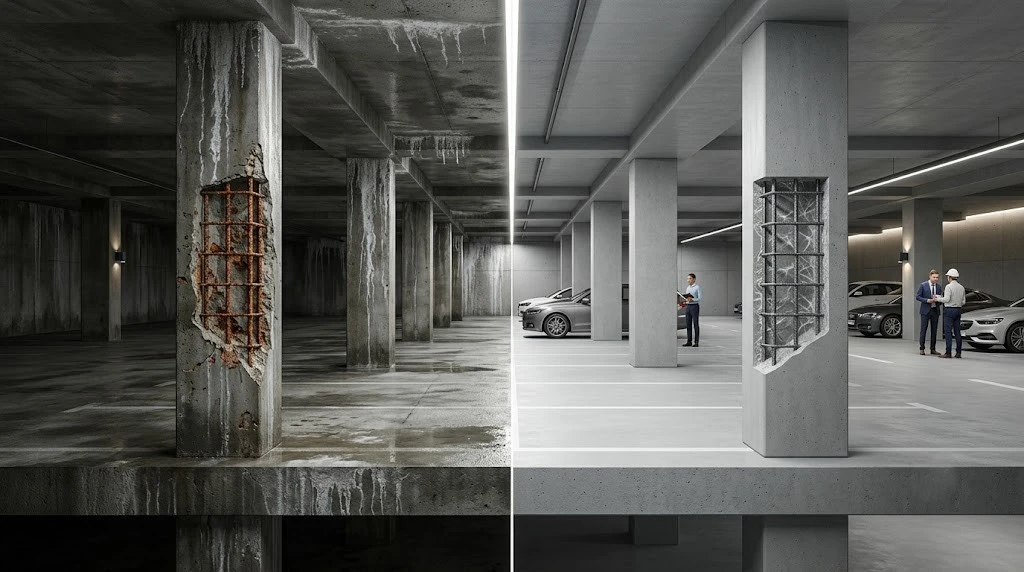
                  Crystalline Waterproofing for Underground Basements and Parking Areas: A Long-Term Solution Against Water Ingress Water intrusion is one of the most common and costly challenges faced by underground structures. Residential basement, commercial parking facility, or large infrastructure project face water seepage that weaken concrete, corrode reinforcement steel, create damp conditions,
                       
                      Need Help?